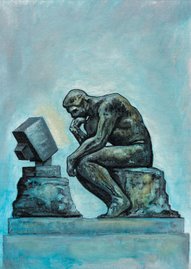
To Teach Is To Light A Life Forever

Teaching must be approached with a passion not different from loving. Teachers who display an intense love for teaching do inspire their students and infuse them with enthusiasm to take their learning seriously and joyfully.

According to Aruppe, a teacher has to be in love for nothing is more practical for a teacher than falling in love with his calling in an almost absolute way. When you are in love with your teaching, it seizes your imagination, will affect everything in your life. It will decide what will get you out of bed in the morning, what you will do with your evenings, how you spend your weekends, what you read, what you know that breaks your heart, and what amazes you with joy and gratitude.

We teachers are reminded to fall in love with our calling. If we stay in love, it will decide everything. Yes, teaching is tiring, but when we teach, it will light a life forever.

e enjte, 16 gusht 2007

Conditional Syllogism

2.Conditional Syllogism – a syllogism whose major premise is a conditional proposition. It is a mixed conditional syllogism if the minor premise is a conditional proposition or a pure conditional syllogism if both premises are conditional propositions.

a.The mixed conditional syllogism is governed by the two laws that governed relationship between the antecedent and the consequent.

1.If the antecedent is true and the sequence valid, the consequent

is true.

2. If the consequent is false and the sequence valid, the antecedent

Is false.

When applied to the mixed conditional syllogism, these general rules are

expressed thus:

If the antecedent is posited or affirmed in the minnow premise, then the consequent is also posited or affirmed in the conclusion.

VALID

If A then B

But A

Therefore B

INVALID

If A then B

But not A

Therefore not B

If the consequent is sublated or denied in the minor premise then the antecedent is sublated or denied in the conclusion.

VALID

If A then B

But not B

Therefore not A

INVALID

If A then B

But not B

Therefore not A

b.The purely conditional syllogism, which has conditional syllogism, which has conditional propositions for both its premises, has exactly the same forms and the same rules as the mixed conditional syllogism except that the condition expressed in the minor premise must be retained in the conclusion.

If A is B, then C is D;

But if X is Y, then A is B;

Therefore if X is Y, then C is D.

If A is B, then C is D;

But if X is Y, then C is not D;

Therefore if X is Y, then A is not B.

If he has terminal cancer, then he is seriously ill.

But if he is undergoing chemotherapy, then he has terminal cancer.

Therefore if he is undergoing chemotherapy, then he is seriously ill.

If he has terminal cancer, then he is seriously ill.

But if he can go about his daily work, then he is not seriously ill.

Therefore if he can go about his daily work, he has no terminal cancer.

Hypothetical Propositions

A hypothetical syllogism is a syllogism that has a hypothetical proposition as one of its premises.

1.Hypothetical Propositions – A hypothetical proposition is one whose predicate does not assert of the subject in an absolute manner. There are three kinds of hypothetical propositions:

a.conditional (if…, then…) – the assertion of the consequent is dependent upon

the condition established by the antecedent.

If the elections will not push through then there will violence in the country.

b.disjunctive (either…, or…) – affirms the possibility of one or more of the

alternatives.

A candidate for public office is either qualified on unqualified.

c.conjunctive (not both…, and…) – denies the simultaneous possibility of both

alternatives.

The farmer cannot be environment friendly and not environment friendly at the

same time.

Rules of Syllogism

  1. Rules of Syllogism – There are five rules that govern the categorical syllogism:

Rule 1: There must be three terms and only three – the major term, the minor term, and the middle term. If there are only two terms the relationship between these two cannot be established. And if there were more than three terms this would violate the structure of the categorical syllogism.

Animals are living beings.

Plants are heavenly bodies.

Therefore…

Stones are minerals.

Minerals are stones.

Therefore…

A widower is a man.

A man is either male or female.

Therefore, a widower is either male or female.

Rule 2: Each term must occur twice in the syllogism: the major must occur in the conclusion and in one premise, the minor in the conclusion and in one premise; the middle in both premise but not in the conclusion. There must therefore be a total of three propositions in the syllogism.

Rule 3: The middle term must be distributed at least once. If the middle term is particular in both premises it might stand for a different portion of its extension in each occurrence and thus be equivalent to two terms.

All sharks are fish.

All salmon are fish.

Therefore, all salmons are sharks.

Many rich men oppress the poor.

Jones is a rich man.

Therefore, Jones oppresses the poor.

Rule 4: The major and minor terms may not be universal in the conclusion unless they are universal in the premises. If a term is distributed in the conclusion then it must be distributed first in the premise.

There is an illicit major term if the major term is universal in the conclusion but particular in the premise:

All horses are animals.

All dogs are not horses.

Therefore, all dogs are not animals.

There is an illicit minor term if the minor term is universal in the conclusion but particular in the premise:

All tigers are mammals.

All mammals are animals.

Therefore, all animals are tigers.

The rationale behind this rule is that we may not conclude about all the inferiors of a term if the premises have given us information about only some of them. The key to detect a violation of this rule is to examine the conclusion. If there is no term that is distributed in the conclusion then this rule could not have been violated. If one or both terms in the conclusion are distributed there is possibility of the rule having been violated. If a term is distributed both in the premise and the conclusion there is no violation of this rule.

Rule 5: If both premises are affirmative, the conclusion must be affirmative. The reason for this rule is that affirmative premises either unite the minor or major terms, or else do not bring them into relationship with each other at all.

All sins are detestable.

All pretenses are a sin.

Therefore, all pretenses are not detestable.

There is a need to be cautious about apparently affirmative or negative propositions:

Animals differ from angels.

Man is an animal.

Therefore, a man is not a horse.

Rule 6: If one premise is affirmative and the other negative, the conclusion must be negative.

All crows are birds.

All wolves are not crows.

Therefore, all wolves are birds.

Some premises are apparently affirmatives but actually negative and therefore yield a valid conclusion:

Dogs are not cats.

Greyhounds are dogs.

Therefore, greyhounds differ from cats.

Rule 7: If both premises are negative – and not equivalently affirmative – there can be no conclusion.

Reptiles are not mammals.

Dogs are not reptiles.

Therefore…

Rule 8: If both premises are particular there can be no conclusion.

Structure of Syllogism

A syllogism is a deductive argument cocsisting of two premises and one conclusion. It is called a categorical syllogism if all the propositions are categorical propositions.

  1. Structure of the Syllogism – The propositions must contain a total of three terms. A synonym introduced into one of the propositions does not add another term into the syllogism.

All philanthropists are wealthy persons.

No wealthy persons are selfish.

Therefore, no philanthropists are selfish.

All businessmen are wealthy persons.

All rich persons are hardworking individuals.

Therefore, all businessmen are hardworking individuals.

Each of the terms must be used in the same sense throughout the syllogism. If a term is used in different senses it would not count as one term and so there will result more than three terms.

The poor need government subsidy.

These students are poor.

Therefore, these students need government subsidy.

The propositions need to be in their standard form; however, analysis is greatly simplified if the propositions are in standard form.

The three terms of the categorical syllogism are the major term, the minor term, and the middle term. The major term is the predicate of the conclusion. The minor term is the subject of the conclusion. And the middle term is that which provides the linkage between the two premises. It is thus found in both premises but never in the conclusion. A premise is designated as major or minor depending on the term it carries.

The categorical syllogism is in a standard logical form when the premises are strictly categorical propositions, the two usages of each term are identical, and the major premise is listed first followed by the minor premise and then the conclusion.

Equivalence of Propositions

  1. Equivalence of Propositions – the formulation of a new proposition, with the same meaning as the original, by interchanging the subject and predicate terms of the latter and/or by the use or removal of negatives.

1. conversion – interchanging the subject and predicate terms of the original but leaving its quality unchanged.

convertend

original proposition

S is P

converse

resultant proposition

Ps is Sp

1.a. simple done by simply interchanging subject and predicate terms because they have the same quantity. Note that the quantity of the converse should be the same as the quantity of the convertend.

E – E

No dog is a cat – No cat is a dog.

I - I

Some pictures are clear prints – Some clear print are pictures.

1.b. partial – the unioversal quantity of the convertend becomes particular in the converse.

A – I

All horses are animals – Some animals are horses.

It is advisable to reduce a proposition to its logical form before attempting conversion. Simple conversion is applied to a singular proposition whose predicate is also singular.

2. obversion – formulating a new proposition [obverse] by retaining the subject term and quantity of the original proposition [obvertend], changing its quality, and using as predicate term the contradictory of the original predicate term. The procedure for obversion is as follows:

1. Retain the subject quality of the obvertend.

2. Change the quality.

3. As new predicate, use the contradictory of the predicate of the obvertend.

A – E

All me are sinful.

-

All me are not sinless.

I - O

Some house are white.

-

Some houses are not non-white.

E – A

No person is indispensable.

-

All persons are dispensable.

O - I

Some jewels are not rare.

-

Some jewels are non-rare.

3. contraposition – the formulation of a new proposition [contraposit] whose subject is the contradictory of the predicate of the original proposition [contraponend]. There are two types of contraposition and the corresponding procedures are as follows:

Type 1:

1. Obvert

2. Convert the obverse.

[contraponend] A - E [contraposit]

E - I

O - I

A - E

Every dog is an animal.

Every dog is not a non-animal.

Every non-animal is a dog.

E - I

No dog is a cat.

All dogs are non-cats.

Some non-cats are dogs.

O - I

Some men are not voters.

Some men are non-voters.

Some non-voters are men.

Type 2:

1. Obvert.

2. Convert the obverse.

3. Then obvert the converse of the obverse.

[contraponend] A - A [contraposit]

E - O

O - I

A - A

Every man is mortal.

Every man is not immortal.

Every immortal is not a man.

Every immortal is a non-man.

E - O

No dog is a cat.

All dogs are non-cats.

Some non-cats are dogs.

Some non-cats are not non-dogs.

O - I

Some men are not voters.

Some men are non-voters.

Some non-voters are men.

Some non-voters are not non—men.

Opposition of Proposition

  1. Opposition of Proposition – the difference as to quantity or quality or both of two propositions having the same subject term and predicate term.

    1. contradictory – difference of two propositions as to quantity and quality such that one is necessarily the negation of the other. Both cannot be true but both cannot be false.

If one is true, the other is false and vice-versa

A vs O

E vs I

    1. contrary – difference as to quality of two universal propositions. Both cannot be true but both can be false.

If one is true, the other is false; if one is false the other is

doubtful.

A vs E

    1. subcontrary – difference of two particular propositions as to quality. Both can be true but both cannot be false.

If one is false the othet is true; if one is true the other is

doubtful.

I vs O

    1. subalternate – difference as to quantity of two propositions having the same quality, between a universal proposition (superaltern) and its corresponding particular (subaltern).

If the superaltern is true, the subaltern is also true but not

vice-versa. If the subaltern is false, the superaltern is also

false but not vice-versa.

A vs I

E vs O

A being true

E is false

I is true

O is false

E being true

A is false

I is false

O is true

I being true

E is false

A is doubtful

O is doubtful

O being true

A is false

E is doubtful

I is doubtful

A being false

O is true

E is doubtful

I is doubtful

E being false

I is true

A is doubtful

O is doubtful

I being false

A is false

E is true

O is true

O being false

A is true

E is false

I is true

Classification of Proposition

  1. Classification of Propositions – There are four kinds of categorical propositions:

    1. those that assert that the whole subject class included in the predicate class;
    2. those that assert that the whole subject class is excluded from the predicate class;
    3. those that assert that part of the subject class is included in the predicate; and,
    4. those that assert that part of the subject class is excluded from the predicate class.

A

Universal-Affirmative

All S are P

All politicians are honorable men.

E

Universal-Negative

All S are not P

All politicians are not honorable men.

I

Particular-Affirmative

Some S are P

Some politicians are honorable men.

O

Particular-Negative

Some S are not P

Some politicians are not honorable men.

Form A

All S are P asserts that the predicate is affirmed of all members of S, the subject category.

Form E

No S are P asserts that the predicate is denied of all members of S.

Form I

Some S are P asserts that there is at least one member of S and the predicate is affirmed of it.

Form O

Some S are not P asserts that there is at least one of S and the predicate is denied of it.

All S are P

Every member of the S class is a member of the P class; that is, the S class is included in the P class.

No S are P

No member of the S class is a member of the P class; that is, the S class is excluded from the P class.

Some S are P

At least one member of the S class is a member of the P class.

Some S are not P

At least one member of the S class is not a member of the P class.